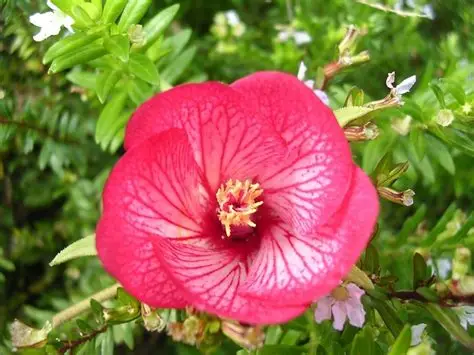
Boucle d'Oreille
VerifiedTrochetia boutoniana
Scientific Classification
Endangered
Very high risk of extinction
About This Species
The Trochetia boutoniana, known by its Creole name "Boucle d'Oreille" (meaning "earring" due to its bell-shaped flowers), is the National Flower of Mauritius since 1992. This remarkable shrub is endemic to Mauritius and represents the island's unique botanical heritage.
Named after French botanist Louis Bouton, this species is one of the most iconic plants of Mauritius. Note: The species was recently reclassified as Ruizia boutoniana in 2020 when the genus Trochetia was merged into Ruizia.
Physical Characteristics
The Boucle d'Oreille is a small shrub that produces distinctive reddish-orange bell-shaped flowers. One of the most remarkable features of this plant is its scarlet-colored nectar - it belongs to the few plant species worldwide that produce coloured nectar.
Scientists believe this characteristic may be linked to now-extinct bird species that once pollinated these plants. The hermaphroditic flowers bloom from June to October.
Habitat & Distribution
Natural Habitat
This endemic species is found exclusively on the slopes of Le Morne Brabant, a UNESCO World Heritage Site in southwest Mauritius. It grows in the dry, rocky terrain of the mountain slopes at elevations where the microclimate provides suitable conditions.
Traditional & Medicinal Uses
Traditional Uses
While not extensively used traditionally, the Boucle d'Oreille has significant cultural and symbolic importance as the national flower. It represents Mauritius's unique endemic flora and the importance of conservation.
Medicinal Uses
No documented medicinal uses. The plant is primarily valued for its ornamental beauty and its status as a national symbol.
Ecological Role
The Boucle d'Oreille plays an important role in the ecosystem as a nectar source for native pollinators. Its colored nectar was likely adapted to attract specific bird pollinators, some of which may now be extinct.
The genus Trochetia includes six species, all endemic to the Mascarene Islands, making it an important group for understanding island biogeography.
Conservation
Threats
Major threats include:
- Invasive species - Competition from introduced plants like Chinese guava (Psidium cattleyanum)
- Habitat destruction - Loss of native forest habitat
- Introduced animals - Damage from rats and monkeys
- Climate change - Changing rainfall patterns affecting flowering
Conservation Efforts
Conservation efforts include:
- Protection under Mauritian environmental laws
- Habitat restoration at Le Morne Brabant
- Ex-situ conservation in botanical gardens
- Public awareness campaigns about the national flower
- Research into propagation techniques
Sources & References
IUCN Red List, Wikipedia, National Parks and Conservation Service Mauritius, Royal Botanic Gardens Kew

