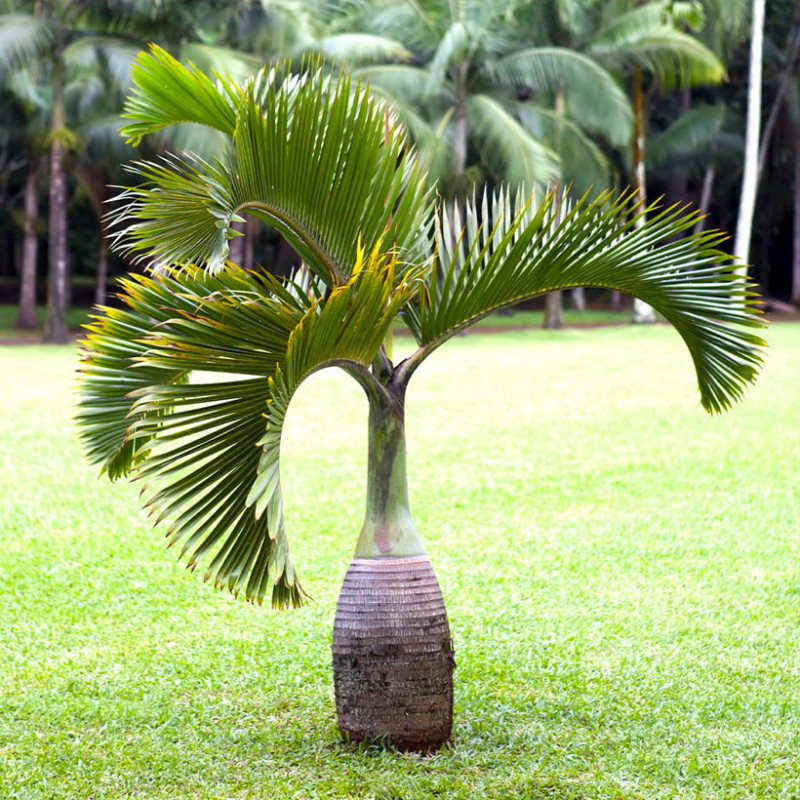
Bottle Palm
VerifiedHyophorbe lagenicaulis
Scientific Classification
Critically Endangered
Extremely high risk of extinction
About This Species
The Bottle Palm (Hyophorbe lagenicaulis) is a critically endangered palm endemic to Round Island, a small islet off the coast of Mauritius. Its distinctive bottle-shaped trunk has made it one of the most recognizable palm species worldwide.
The species name lagenicaulis comes from Latin lagena (bottle/flask) and caulis (stem), directly describing its unique swollen trunk.
Physical Characteristics
Key characteristics:
- Height: 3-6 meters (10-20 feet) at maturity
- Trunk: Smooth, light gray to white, dramatically swollen at the base into a bottle shape up to 60 cm diameter
- Crownshaft: Distinctive green crownshaft
- Fronds: 4-8 arching pinnate leaves up to 3 meters long
- Leaflets: 100-140 dark green, lance-shaped leaflets arranged in a V-shape
Habitat & Distribution
Natural Habitat
Naturally restricted to Round Island (Île Ronde), a 2.2 km² uninhabited volcanic islet approximately 22.5 km northeast of mainland Mauritius. The palm grows on rocky, well-drained slopes in dry tropical conditions.
Traditional & Medicinal Uses
Traditional Uses
Historically, palms of this genus were harvested for their palm hearts, which contributed to their decline. Today, the Bottle Palm is primarily valued as an ornamental specimen.
Medicinal Uses
No documented medicinal uses. The species is protected and harvesting is prohibited.
Ecological Role
The Bottle Palm is part of the unique Round Island ecosystem, which also hosts other endemic species including reptiles. Its fruits provide food for native wildlife and the plant contributes to soil stabilization on the volcanic slopes.
Conservation
Threats
Historical threats:
- Habitat destruction - Species became extinct on mainland Mauritius by the early 19th century
- Overgrazing - Introduced rabbits and goats devastated Round Island vegetation
- Population crash - From 15 mature individuals in 1975 to only 2 by 1996
Current threats include climate change and potential disease.
Conservation Efforts
Successful conservation measures:
- Removal of introduced herbivores from Round Island
- Natural regeneration occurring on the island
- Ex-situ cultivation worldwide ensures species survival
- Round Island designated as a nature reserve
The species is now widely cultivated as an ornamental palm throughout the tropics, ensuring its survival even if wild populations fail.
Sources & References
IUCN Red List, Wikipedia, Palmpedia, Royal Botanic Gardens Kew


